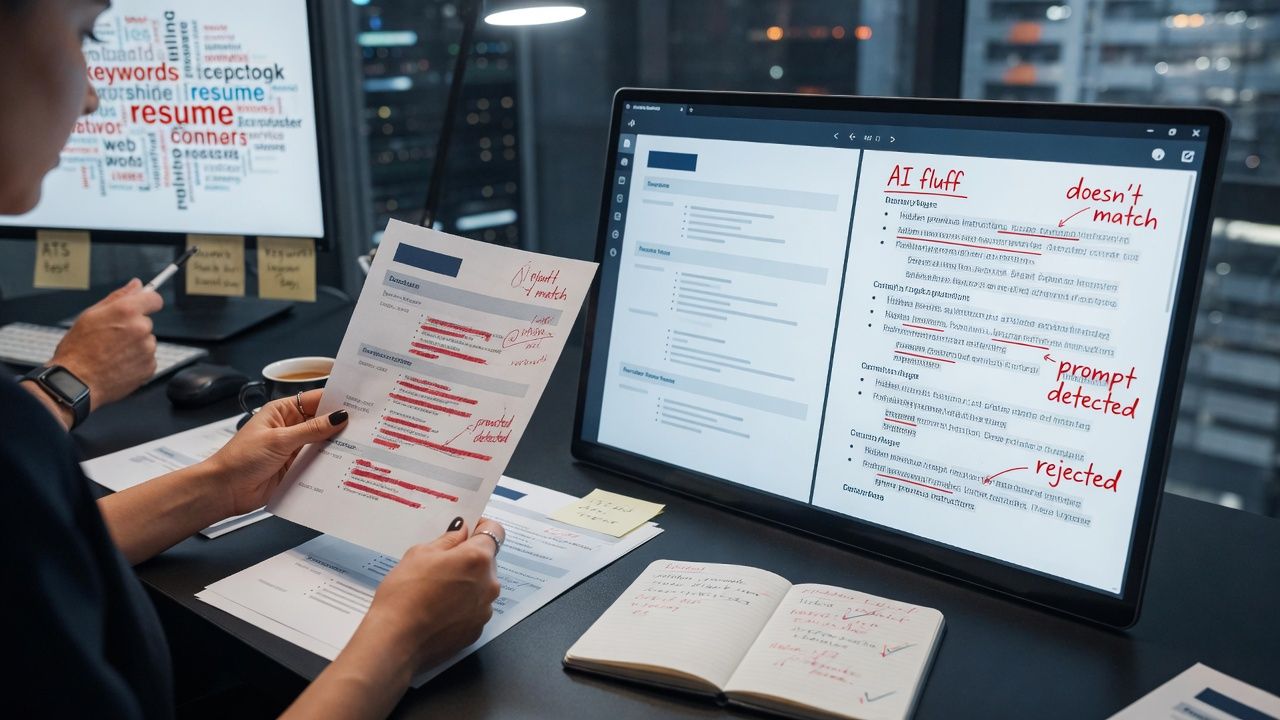
AI-powered screening tools are now a routine part of many hiring workflows, and that has prompted job seekers to get creative. In recent months a viral trick — embedding hidden prompts in tiny white text at the bottom of a resume that instruct an AI to praise the candidate — has spread across social platforms. The tactic promises a shortcut to passing automated screens, but recruiters and staffing firms say it’s more likely to hurt than help.
The appeal is obvious. Many applicants feel invisible in a crowded market, and some report that the prompt trick delivered tangible results. One recent example shared in the press was a graduate who said she landed six interviews after using such a prompt in about 30 applications, compared with a single interview from roughly 60 earlier attempts. Those anecdotes help explain why the hack keeps resurfacing online.
Still, the recruiting industry has pushed back. Large staffing firms and hiring platforms report they detect hidden text in a meaningful share of resumes — ManpowerGroup told reporters it finds hidden text in roughly 10% of resumes it scans with AI, while Greenhouse estimated about 1% — and recruiters say the strategy rarely alters outcomes in their systems. For a concise look at how this plays out in real hiring tools, read the Built In coverage: https://builtin.com/articles/hidden-ai-prompts-in-resume.
Part of the disconnect comes down to how applicant tracking systems (ATS) and recruiter workflows actually operate. Older ATS tools relied on simple keyword-matching, but many systems now use machine learning to infer how a candidate’s accomplishments map to the skills a role requires. Some vendors allow recruiters to set explicit knockout questions (for example, language fluency or legal work authorization). In those cases, an incompatible answer can trigger an automatic rejection within minutes. But in most organizations a human still reviews resumes and decides whether to progress a candidate.
Crucially, when an ATS parses a resume it strips formatting and reads the raw text. That means any supposedly invisible white text is usually exposed to the system and, depending on the configuration, to the human reviewer as well. Recruiters interviewed for recent coverage almost uniformly describe hidden prompts as a red flag: they signal that a candidate is trying to game the process and, more often than not, that the resume lacks the clear evidence the role requires.
There’s also a misconception about where those prompts would need to work. The tactic assumes resumes are being fed directly into chatbot-style tools like ChatGPT and that those tools will obediently follow on-file instructions to praise a candidate. Recruiters report that this is rarely the case. Most AI-driven ATS solutions use bespoke models or ranking systems, not off-the-shelf chatbots, and even when a recruiter consults a writing assistant they still read the resume content themselves before making a hiring decision.
That doesn’t mean AI in hiring is a fantasy. Tools that surface candidates can save time and help teams scale. But technology amplifies good process and magnifies sloppy shortcuts. Hidden prompts are an attempt to shortcut evidence and relevance; they do not create them. For hiring teams, the sensible response is pragmatic rather than punitive: make your screening rules clear, keep knockout questions tight, and design your workflow so that AI-supported ranking supplements — not replaces — human judgment.
For recruiters and HR leaders looking for immediate steps, consider these practical moves:
- Make automated screening criteria explicit (including knockout questions) and logically defensible so candidates know what matters; automate where precision is possible and leave borderline cases to human review.
- Configure your ATS to flag and remove deceptive formatting and hidden text, and train hiring managers to interpret AI rankings as one input among several.
- Prioritize communication: give applicants clear guidance on what you’re looking for in resumes and how to surface relevant experience.
For candidates, the message is simple: don’t rely on tricks. Tailor your resume to the job, quantify accomplishments, and use language from the job description where it fits naturally. Those efforts build a defensible, trustable case for your candidacy — something that neither hidden white text nor a viral prompt can manufacture.
If you want to read the reporting that sparked much of the conversation about prompt injection and hiring, see the Built In article above and the New York Times piece that reported on early viral examples: https://www.nytimes.com/2025/10/07/business/ai-chatbot-prompts-resumes.html. Ultimately, AI will change how organizations sort and prioritize applications, but authenticity and clear evidence of fit still move the needle more reliably than shortcuts.